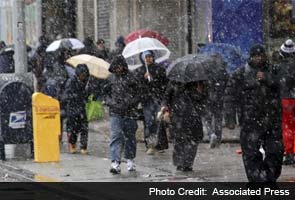
Throughout the night and into the morning airlines announced the suspension of thousands of flights out of New York and Boston airports, as workers in towns and cities across the region readied their ploughs, checked their stocks of salt and braced for what will most likely be a cold and busy weekend. Amtrak announced that beginning early Friday afternoon it would suspend northbound service out of Pennsylvania Station in New York and southbound service out of Boston.
Schools across New York, Connecticut, Massachusetts and Rhode Island announced that they would close, or dismiss students early Friday.
While officials warned people to stay home from work if possible Friday, many kept to their usual morning commute, anticipating that they could get home before the worst of the storm was expected to hit. The latest forecasts said that blizzardlike conditions would start in New York City after dark. To help commuters beat the snow, transit officials announced increased bus and train service in the afternoon.
At 11 a.m. on Friday, forecasters expressed increasing confidence in the strength of the storm.
In New York City, where there is a mix of rain, snow and sleet, a rush of cold air is expected to filter back into the region by 4 p.m., at which point the rain will transition back to snow, said Tim Morrin, a meteorologist at the National Weather Service based in Long Island.
"From then things go downhill pretty quickly," he said. The winds will pick up, and snow will start coming down heavily.
In New England, the storm will intensify at about the same time, but because the area has not had rain, the total snowfalls will be greater.
"The worst conditions will be after dark and overnight," Morrin said. "We don't want to have folks get complacent seeing the rain and the just wet streets."
By Saturday, the total expected snowfall in New York City is expected to be between 10 and 14 inches. In Long Island, the snow totals will range from 14 to 18 inches, with the highest amounts at the east end.
In New London, Conn., there will most likely be more than 24 inches of snow and even more in Boston, which could break modern records by topping 28 inches.
The severe weather is the result of two weather systems colliding, producing a powerful force. One system is coming from the north, carried along by the arctic jet stream, which will drop down from Canada and intersect with another system propelled by the polar jet stream, which usually travels through the lower 48 states.
"The storm should reach its peak intensity early Saturday morning just east of Cape Cod," the National Weather Service said in a statement. With hurricane-force winds, the Weather Service predicted "dangerous blizzard conditions" for many parts of the Northeast. Officials also expect flooding along the Atlantic coast affecting up to 8 million people.
The storm could rival the blizzard of 1978 in New England, when more than 27 inches of snow fell in Boston and surrounding cities. That storm, which occurred on a weekday 35 years ago, resulted in dozens of deaths and crippled the region for days.
Officials expect to be better prepared this time.
In the predawn hours, 300 road crews in Massachusetts started spreading salt and brine.
Even as utility workers across the region scrambled to add extra crews, utilities warned that power failures could persist for several days since workers cannot operate during the height of the storm. Even after the storm passes, downed power lines may need to be dug out from under mounds of snow.
Several cities including Portsmouth, N.H., and Kittery, Maine, have banned parking on their streets.
Jerome Hauer, the New York state commissioner of the Division of Homeland Security and Emergency Services, said that coastal areas of Queens, Brooklyn and Long Island could experience flooding and that residents should be prepared to seek alternative shelter. While the storm surge is expected to be only 3 to 5 feet - well below the 14-foot surge that Hurricane Sandy delivered - he said large waves could bring water inland.
"If you see flooding, have plans for somewhere to go," Hauer said.
In New York City, 1,800 sanitation trucks were at the ready to deal with snow. As conditions worsen they will spread out across 6,300 miles of roadways - roughly the distance from New York to Los Angeles and back - and spread some 250,000 tons of salt as well as work to clear roadways as the snow builds.
Mayor Michael R. Bloomberg, who came under criticism for the city's slow response to a snowstorm in December 2010, sought to reassure New Yorkers that the city was prepared, but urged people to leave work early.
"Our biggest concern is making sure that people get home from their day and that they don't abandon their cars in the middle of the road," Bloomberg said Friday during his morning radio show. "But we don't think the snow is going to come down hard enough where that should be a problem."
Government offices and public schools in New York City remained open Friday, but after-school programs were cancelled. Schools also cancelled entrance exams that had been scheduled for Saturday, and the state cancelled Civil Service exams as well.
For many New Yorkers, the memory of the gas shortages and prolonged power failures that followed Hurricane Sandy are still vivid, and they were taking no chances.
"I don't think it's going to be as bad as they're saying, but I said that with Sandy, too," said Lavel Samuels, 42, as she filled her tank at a gas station in the Far Rockaways. "I'm filling up based on my experience with Sandy, in case there's no gas on Sunday or Monday."
At the Shell station on Beach 59th Street some motorists also filled red spare gas tanks in their trunks for generators they bought to survive the post-hurricane power failures. Josephine Perkins, 55, who is retired, said she had her generators ready and was stocking up on fuel.
"If you get snowed in you just stay inside and ride it out," she said. "We're used to this now."
In Massachusetts, Gov. Deval Patrick said a state of emergency would take effect as of noon on Friday. He called for all cars to be off the streets, saying he would wait to see how conditions were before determining whether to make his request mandatory. Tandem trailers and propane trucks were banned from state highways.
Almost all schools across the state were closed Friday, including the public schools in Boston as well as Harvard and Massachusetts Institute of Technology. Airlines canceled more than 4,000 flights starting Friday afternoon.
Patrick told nonemergency government workers to stay home and urged private employers to issue similar stay-at-home orders.
He said his biggest fear was that people would not take the warnings seriously. He said he understood the tendency, given previous storm warnings that had proved ill-founded, and he recalled his own carefree attitude when he was a student during the 1978 blizzard.
"I remember classmates cross-country skiing down Mass Ave.," he told reporters with a smile. But, he added, "I approach this storm very differently than that because I have to worry about people being safe."

No comments:
Post a Comment